
As an employer, you likely end up with a wide range of documents, from applications and offer letters to performance reviews, compensation changes, and separation records. All of those records matter, but not every document belongs in the same employee file.
Instead, you need to know which employee records to keep, which to store separately and how long to keep each. No single retention period applies to every employee record, and federal, state and local requirements can vary depending on the record type and specific circumstances.
A personnel file is a collection of general employment records you maintain about an employee and is also sometimes called an employee file or referred to as personnel records. The complete HR record for an employee can be larger than their general personnel file, and you might have separate files for medical information, payroll, benefits, I-9 documentation and other specialized records.
When you keep all these categories separate, it can help protect sensitive information and make it easier to set up the right access requirements, so only certain people can see specific data about an employee.
RELATED: Where to File Benefit Enrollment Documents >>
Keeping a well-maintained employee file means including all the general documentation that’s needed to understand your employee’s history with your company and any key employment decisions.
There are multiple types of hiring and onboarding documents, including the employee’s application and resume, a job description, an offer letter, employment agreements, the company handbook and policy acknowledgments, and documentation that’s related to hiring and placement decisions.
Consistent recordkeeping practices are crucial to ensuring you’re keeping the right documents in the right place.
If an employee has been with you for a long time, they’ve probably had changes to their compensation structure and job duties along the way. That might include promotions, title and responsibility changes, compensation changes, transfers and changes to their employment status.
Many employees have documents that detail their performance and any corrective action you’ve required them to take. That can include performance reviews, goals and improvement plans, along with written warnings and training and certification records. These need to be factual and should be handled consistently across all employees, focusing on their conduct, performance or other relevant employment facts, not personal opinions.
When an employee leaves your company, their personnel file might include things like their resignation notice, termination documentation or other records that detail the employment decision. These should be kept based on any legal requirements for retaining them and not automatically deleted after a certain period of time.
Not every employee record should be part of the main employee file, and your complete collection of records for each employee may end up being stored in several different areas. Some HR records, for example, are maintained separately because they have sensitive information or specific legal requirements.
These can include records about:
The key takeaway for you as an employer is that not all human resources records belong in an employee’s general personnel file.
RELATED: 8 Steps to High-Value Employee Performance Documentation >>
Organizing employee personnel files makes recordkeeping more consistent and reduces the risk of misplacing information or making it too accessible.
To stay organized, use consistent file categories and naming conventions for every employee. Also, keep the general personnel information separate from confidential things like payroll, medical, I-9, and other specialized data. Access to these records should be limited based on job responsibilities, instead of giving all of upper management or even HR access.
If you use electronic records, you need filing and naming procedures that stay consistent over time, and you’ll want to ensure you have reliable backups and strong security controls. Paper records should also be stored where they can’t be accessed by just anyone.
Even though employee records need to be stored securely, people who are supposed to have access to them should be able to get to them easily. When all your records are well-organized, it’s easier to respond to employee requests, employment claims, audits and investigations.
How long to keep employee files depends on what’s in those files. There isn’t any single federal retention period that applies to all employee documents.
Some employee records have a specific set of federal rules, while others are controlled by certain agencies or fall under particular Acts. There may also be state requirements to consider.
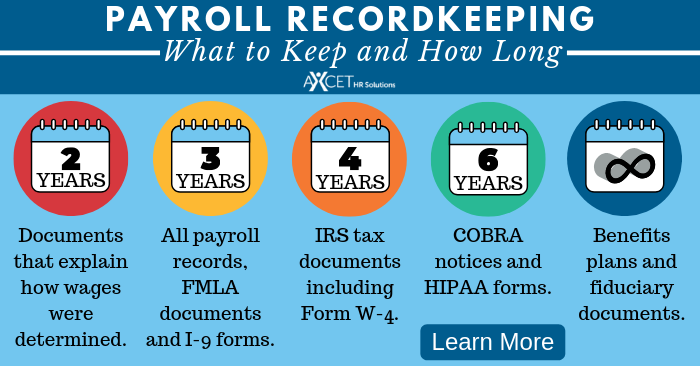
Here’s a high-level reference for several of the most common categories:
| Record Type | Federal Requirement to Address | General Federal Retention Period |
| General personnel and employment records | EEOC record-keeping rules | Generally 1 year; special rules may apply |
| Payroll records | FLSA | At least 3 years |
| Wage calculation records | FLSA | At least 2 years |
| FMLA records | FMLA | At least 3 years |
| Form I-9 | Immigration requirements | 3 years after hire or 1 year after termination, whichever is later |
| Employment tax records | IRS requirements | At least 4 years |
| OSHA injury and Illness records | OSHA | Generally 5 years after the end of the calendar year covered |
| ERISA plan records | ERISA | Certain records at least 6 years; other records may need to be retained longer |
The periods above aren’t universal, and there can be exceptions and additional requirements.
If how long to keep employee personnel files is a question on your list, it’s crucial to know the rules. Even when an employee doesn’t work for you anymore, you still have some recordkeeping obligations, and they don’t all have the same date.
Some timelines for keeping employee records are based on when the employee left your company, while others are based on when the record was created, a tax return was filed, an action occurred, or another event happened.
Because of that, you should focus your retention rules around record category instead of simply waiting a set number of years and then deleting the employee’s entire file. Before you get rid of any past employee records, make sure you determine whether there are any federal, state or local regulations that require you to keep those records longer.
Yes, federal laws establish a number of baseline requirements, but states and local municipalities can also impose longer or additional rules for employee records. That means employee record retention by state is essential to look into if you have workers in multiple jurisdictions.
A retention schedule that works in one location might not satisfy the requirements in another one, so always verify current local requirements before you destroy employee records.
You’ll want to keep records longer when they might be relevant to litigation, a government investigation, an agency charge, an audit, an employment claim or any other type of legal matter.
In other words, any employee record that has made its way to the end of the ordinary retention period shouldn’t be destroyed if there’s another legal requirement showing that it needs to be preserved. If you have a preservation obligation and don’t acknowledge it, that could put you at risk for legal trouble.

Creating a written employee record retention policy gives HR and management a consistent framework they can use to handle employee documents and other human resource records. When you create a policy, you’ll want to define:
Don’t forget to review your policy periodically, because business practices, employment laws and recordkeeping systems change over time.
When you have a consistent process, you know what you have, where it’s stored, and when you can dispose of it. Not only that, but it’s easier to respond to audits, handle disputes and provide accurate information for personnel file requests.
RELATED: Avoid Costly Mistakes - The Importance of an Internal I-9 Audit >>
If you need guidance and support for employee record management, our team at Axcet HR Solutions can help your small or mid-sized business establish practical employee documentation, personnel file and record-retention processes.
From organizing an employee file to developing strong documentation and retention procedures, our professionals understand that the right support can help businesses just like yours maintain efficient records and reduce the risk of inconsistent practices. Get in touch with us today, and let’s have a conversation about how we can help.


Written by
Mariah Collins, SHRM-SCP, is a Human Resources Consultant at Axcet HR Solutions, specializing in people management, process improvement, and project management. With a strong background in payroll, benefits, and employee relations, she brings over four years of experience in providing HR solutions to small businesses.
Mariah holds a Bachelor of Business Administration in Human Resources from Emporia State University and is known for her expertise in helping businesses streamline HR processes while ensuring compliance. Her contributions to the Axcet blog reflect her deep understanding of HR challenges and her commitment to supporting small business owners.



Let us know what you think...